If you are trying to update Eclipse Galileo (3.5) and Helios (3.6) behind Proxy, you might run into problems like "Site is not found".
So, obvious course of action would be to check Proxy Configuration. Now, you change the settings and ensure that it has right authorization details.
Even after these steps, eclipse would fail to update and error message remains same.
It sounds baffling and it sure is.
After doing some googling for it, I found that Eclipse 3.5 onwards, FileTransferAPI has been changed. In ECF 3.0/Eclipse 3.5 the primary provider is based upon Apache httpclient 3.1. This was introduced in the ECF 3.0/Eclipse 3.5 cycle because the previous provider that was based upon the JRE URLConnection implementation proved insufficiently reliable (i.e. see bug 166179).
Unfortunately, the Apache httpclient implementation, although more robust than the URLConnection-based provider, does not support NTLMv2 proxies directly (for an explanation of why, see here).
For NTLMv2 Proxies, that require username and password for access the workaround is to
1. Disable the ECF httpclient provider.
2. Provide the NTLMv2 proxy authentication info (proxyhost, domain, username, and password)
In ECF 3.0/Galileo both can be done via system properties provided to Eclipse on startup. Here is an example using 'myproxy', 'mydomain', 'myusername', and 'mypassword':
Following settings can be put in eclipse.ini so that Eclipse does not use HTTPClient
-Dorg.eclipse.ecf.provider.filetransfer.excludeContributors=org.eclipse.ecf.provider.filetransfer.httpclient
-Dhttp.proxyPort=8080
-Dhttp.proxyHost=myproxy
-Dhttp.proxyUser=mydomain\myusername
-Dhttp.proxyPassword=mypassword
-Dhttp.nonProxyHosts=localhost|127.0.0.1
once you do this, you should be able to update Eclipse.
References:
Monday, January 31, 2011


Tuesday, January 25, 2011
Setting up Apache Solr in Eclipse with Tomcat
Prerequisites for this exercise:
• Apache Solr 1.4.1 ( or some other release)
• Eclipse WTP
• Apache Tomcat 6.x
Steps are:
1. Extract Solr-1.4.1 release into C:\ Drive. For my example, directory is C:\apache-solr-1.4.1
2. Launch Eclipse and create a workspace, say solr-workspace
3. Import apache-solr-1.4.1.war file in your workspace by clicking on FIle -> Import,
Select Web --> War as the Import Source.
WAR File: C:\apache-solr-1.4.1\dist\apache-solr-1.4.1.war
Web Project: apache-solr-1.4.1
Click on Finish.
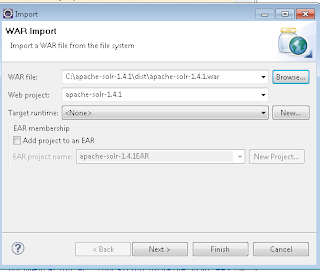
4. Create a folder called solr in the project and create another folder called conf inside solr as shown below:
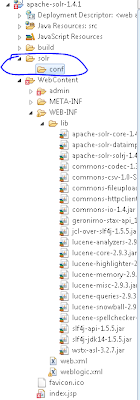
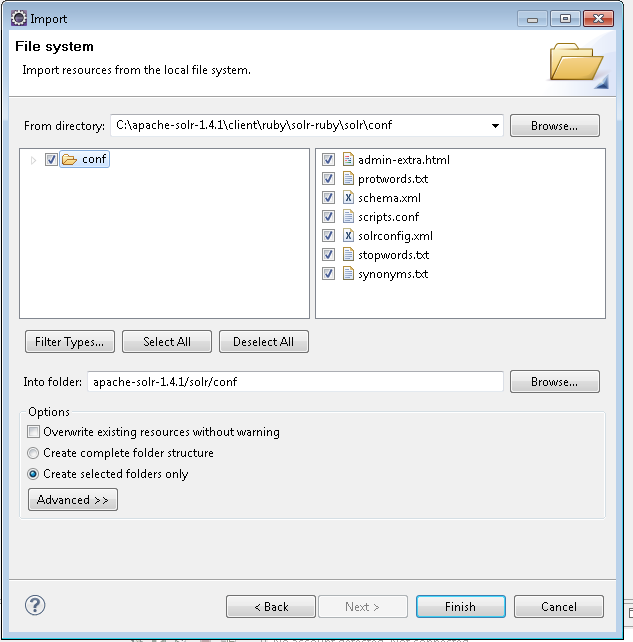
5. Copy files from C:\apache-solr-1.4.1\client\ruby\solr-ruby\solr\conf into /solr/conf folder.
You can define your schema in schema.xml
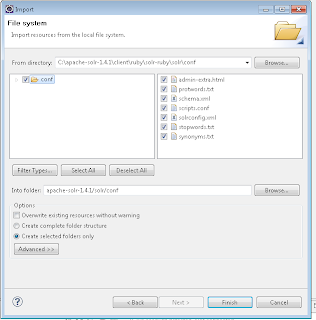
6. Create a Tomcat Server using server wizard. Defaults would work fine.
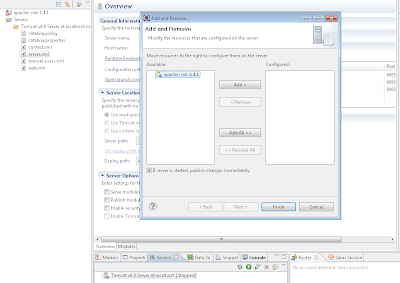
7. Add project apache-solr-1.4.1 to your server as shown below
8. Edit server.xml to let tomcat know where are solr config files are:
<Context docBase="apache-solr-1.4.1" path="/apache-solr-1.4.1"
reloadable="true" source="org.eclipse.jst.j2ee.server:apache-solr-1.4.1">
<Environment name="solr/home" type="java.lang.String"
value="C:\myworkspaces\solr-workspace\apache-solr-1.4.1\solr" override="true"/>
</Context>
9. Start Server and you should see following
INFO: Using JNDI solr.home: C:\myworkspaces\solr-workspace\apache-solr-1.4.1\solr
INFO: Solr home set to 'C:\myworkspaces\solr-workspace\apache-solr-1.4.1\solr\'
Troubleshooting Tips
If your installation is showing errors that solr home is not found then do following
• ensure that server.xml is having right entry
• solr directory exists and has conf as child folder and all the files are there
• clean tomcat-server and clean tomcat work directory
• Apache Solr 1.4.1 ( or some other release)
• Eclipse WTP
• Apache Tomcat 6.x
Steps are:
1. Extract Solr-1.4.1 release into C:\ Drive. For my example, directory is C:\apache-solr-1.4.1
2. Launch Eclipse and create a workspace, say solr-workspace
3. Import apache-solr-1.4.1.war file in your workspace by clicking on FIle -> Import,
Select Web --> War as the Import Source.
WAR File: C:\apache-solr-1.4.1\dist\apache-solr-1.4.1.war
Web Project: apache-solr-1.4.1
Click on Finish.

4. Create a folder called solr in the project and create another folder called conf inside solr as shown below:

5. Copy files from C:\apache-solr-1.4.1\client\ruby\solr-ruby\solr\conf into /solr/conf folder.
You can define your schema in schema.xml

6. Create a Tomcat Server using server wizard. Defaults would work fine.

7. Add project apache-solr-1.4.1 to your server as shown below
8. Edit server.xml to let tomcat know where are solr config files are:
<Context docBase="apache-solr-1.4.1" path="/apache-solr-1.4.1"
reloadable="true" source="org.eclipse.jst.j2ee.server:apache-solr-1.4.1">
<Environment name="solr/home" type="java.lang.String"
value="C:\myworkspaces\solr-workspace\apache-solr-1.4.1\solr" override="true"/>
</Context>
9. Start Server and you should see following
INFO: Using JNDI solr.home: C:\myworkspaces\solr-workspace\apache-solr-1.4.1\solr
INFO: Solr home set to 'C:\myworkspaces\solr-workspace\apache-solr-1.4.1\solr\'
Troubleshooting Tips
If your installation is showing errors that solr home is not found then do following
• ensure that server.xml is having right entry
• solr directory exists and has conf as child folder and all the files are there
• clean tomcat-server and clean tomcat work directory
Friday, January 07, 2011
Computer says no
Good read about how messy the computer systems are, at big banks.
As a result banks tend to operate lots of different databases producing conflicting numbers. “The reality was you could never be certain that anything was correct,” says a former executive at Royal Bank of Scotland. Reported numbers for the bank’s exposure were regularly billions of dollars adrift of reality, he reports; finding the source of the error was hard.
As a result banks tend to operate lots of different databases producing conflicting numbers. “The reality was you could never be certain that anything was correct,” says a former executive at Royal Bank of Scotland. Reported numbers for the bank’s exposure were regularly billions of dollars adrift of reality, he reports; finding the source of the error was hard.
Saturday, March 06, 2010
Declarative Programming Vs Imperative Programming
principal distinction between declarative languages and imperative languages is that declarative languages allow the programmer to concentrate on the logic of an algorithm (declarative languages are goal driven, control is not the concern of the programmer), while imperative languages require the programmer to focus on both the logic and control of an algorithm.
Characteristics of imperative languages:
1. Model of computation based on a step by step sequences of commands.
2. Program states exactly how the result is to be obtained.
3. Destructive assignment of variables.
4. Data structures changed by successive destructive assignments.
5. Order of execution is crucial, commands can only be understood in context of previous computation due to side effects.
6. Expressions/definitions cannot be used as values.
7. Control is the responsibility of the programmer.
Characteristics of declarative languages:
1. Model of computation based on a system where relationships are specified directly in terms of the constituents of the input data.
2. Made up of sets of definitions or equations describing relations which specify what is to be computed, not how it is to be computed.
3. Non-destructive assignment of variables.
4. Explicit representations for data structures used.
5. Order of execution does not matter (no side effects).
6. Expressions/definitions can be used as values.
You can get more info here.
Characteristics of imperative languages:
1. Model of computation based on a step by step sequences of commands.
2. Program states exactly how the result is to be obtained.
3. Destructive assignment of variables.
4. Data structures changed by successive destructive assignments.
5. Order of execution is crucial, commands can only be understood in context of previous computation due to side effects.
6. Expressions/definitions cannot be used as values.
7. Control is the responsibility of the programmer.
Characteristics of declarative languages:
1. Model of computation based on a system where relationships are specified directly in terms of the constituents of the input data.
2. Made up of sets of definitions or equations describing relations which specify what is to be computed, not how it is to be computed.
3. Non-destructive assignment of variables.
4. Explicit representations for data structures used.
5. Order of execution does not matter (no side effects).
6. Expressions/definitions can be used as values.
You can get more info here.
Tuesday, August 11, 2009
How to get MQ JMS Calls log
If you want to enable trace log for Websphere Java MQ and JMS Calls then you need to add following properties while starting tomcat/WAS/java program
-Djava.library.path="C:\WAS_MQ_LIB" It should be the path to the directory where mq related jars are available
-DMQJMS_TRACE_LEVEL="base" – it will do max logging
-DMQJMS_TRACE_DIR="c:\LOGS" – path to the directory where log should be written to
-Djava.library.path="C:\WAS_MQ_LIB" It should be the path to the directory where mq related jars are available
-DMQJMS_TRACE_LEVEL="base" – it will do max logging
-DMQJMS_TRACE_DIR="c:\LOGS" – path to the directory where log should be written to
Thursday, July 30, 2009
Ibatis error: Error parsing XPath '/sqlMap/insert'. Cause: java.util.NoSuchElementException
If IBatis is throwing following exception then apart from usual suspects of correct dtd declaration in sql-map-config xml and sql-map xml files, one should also look at the insert sql definition in sql-map xml.
com.ibatis.common.xml.NodeletException: Error parsing XML. Cause: java.lang.RuntimeException: Error parsing XPath '/sqlMapConfig/sqlMap'. Cause: com.ibatis.common.xml.NodeletException: Error parsing XML. Cause: java.lang.RuntimeException: Error parsing XPath '/sqlMap/insert'. Cause: java.util.NoSuchElementException
I had something like this in my insert query xml definition:
INSERT INTO TEST_T (ACCT_ID) VALUES (#acctId)
above mentioned sql statement throws com.ibatis.common.xml.NodeletException which is difficult to figure out.
In my case, error is due to not having closing hash (#) with acctId
If i change the insert statement to following then things work again, notice the closing # in #acctId#
INSERT INTO TEST_T (ACCT_ID) VALUES (#acctId#)
Hope that this is of some use to others who get this error.
com.ibatis.common.xml.NodeletException: Error parsing XML. Cause: java.lang.RuntimeException: Error parsing XPath '/sqlMapConfig/sqlMap'. Cause: com.ibatis.common.xml.NodeletException: Error parsing XML. Cause: java.lang.RuntimeException: Error parsing XPath '/sqlMap/insert'. Cause: java.util.NoSuchElementException
I had something like this in my insert query xml definition:
INSERT INTO TEST_T (ACCT_ID) VALUES (#acctId)
above mentioned sql statement throws com.ibatis.common.xml.NodeletException which is difficult to figure out.
In my case, error is due to not having closing hash (#) with acctId
If i change the insert statement to following then things work again, notice the closing # in #acctId#
INSERT INTO TEST_T (ACCT_ID) VALUES (#acctId#)
Hope that this is of some use to others who get this error.
Wednesday, July 22, 2009
150 is the limit of human brain!
This article from July/August 2009 issue of IEEE Security & Privacy states that based on research, it has been found that 150 is the limit of human brain to recognize other people, personally.
It has been this way forever and military formations also follow this rule and so do other tribes.
More can be read here.
It has been this way forever and military formations also follow this rule and so do other tribes.
More can be read here.
Wednesday, May 27, 2009
How to fix Spring and MQ issue of Failed to convert property value of type [javax.naming.Reference] to required type [javax.jms.ConnectionFactory]
I ran into this exception and had to waste some hours to fix it. I was using Rational Application Developer 6 with Websphere MQ 5.3 to run a command line client. It should be valid for even higher versions of RAD and WMQ.
Exception is
org.springframework.beans.TypeMismatchException: Failed to convert property value of type [javax.naming.Reference] to required type [javax.jms.ConnectionFactory] for property 'targetConnectionFactory';
I hope that following will help others who run into this issue.
Steps you can take to solve this are:
1) Make sure that you have following jars in classpath:
* com.ibm.mq.jar
* com.ibm.mqbind.jar
* com.ibm.mqjms.jar
* ecutils.jar
* j2ee.jar
* messaging.jar
* messagingClient.jar
* messagingImpl.jar
* namingclient.jar
2) If above is there in classpath but you are still getting this error then check if you have conflicting version of jms related classes.
Sometimes, we have 2 different versions of jms.jar or jms related classes.
Make sure that you have right version of classes.
3) If you suspect class loading issue then use -verbose as a vm argument to see the classloading details.
See following article for RAD and JMS for more details.
Exception is
org.springframework.beans.TypeMismatchException: Failed to convert property value of type [javax.naming.Reference] to required type [javax.jms.ConnectionFactory] for property 'targetConnectionFactory';
I hope that following will help others who run into this issue.
Steps you can take to solve this are:
1) Make sure that you have following jars in classpath:
* com.ibm.mq.jar
* com.ibm.mqbind.jar
* com.ibm.mqjms.jar
* ecutils.jar
* j2ee.jar
* messaging.jar
* messagingClient.jar
* messagingImpl.jar
* namingclient.jar
2) If above is there in classpath but you are still getting this error then check if you have conflicting version of jms related classes.
Sometimes, we have 2 different versions of jms.jar or jms related classes.
Make sure that you have right version of classes.
3) If you suspect class loading issue then use -verbose as a vm argument to see the classloading details.
See following article for RAD and JMS for more details.
Thursday, February 26, 2009
Using Java to Crack Office 2007
Using Java to Crack Office 2007 is a good article by Ted Neward - it shows how you can read word 2007 using plain java - thanks to new OOXML
Thursday, January 29, 2009
Finding out major mail servers of the world
This article is great about how to identify the mail servers, out there in the wild.
What is interesting is to look at mail server responses...
What is interesting is to look at mail server responses...
Tuesday, January 20, 2009
Physiological Basis of Yoga
Yoga is known to have done wonders for people. This article goes into some details to explain the physiological basis for this.
Wednesday, January 07, 2009
Code Quality: Coupling, Afferent and Efferent and Code Quality
All Software Projects deviate from their original design, as the time goes by. This is specially true
as code base gets bigger and new developers join in.
Maintaining the intention of design and keep things manageable, becomes tougher and tougher.
To handle this kind of situation, we need some support from Tools to properly understand
the coupling of code, their complexity and their test coverage. Without this information,
it is nearly impossible to know the cost of change in system.
Thankfully, we have JDepend which can help us deal with these kind of issues. It gives
us a measure of afferent (how many packages depend on you) and efferent coupling (how many
packages you depend on), Abstactedness, Instability.
Do read this article to know more about it.
Good news is that you can integrate this into your eclipse workspace too, via an eclipse plugin.
as code base gets bigger and new developers join in.
Maintaining the intention of design and keep things manageable, becomes tougher and tougher.
To handle this kind of situation, we need some support from Tools to properly understand
the coupling of code, their complexity and their test coverage. Without this information,
it is nearly impossible to know the cost of change in system.
Thankfully, we have JDepend which can help us deal with these kind of issues. It gives
us a measure of afferent (how many packages depend on you) and efferent coupling (how many
packages you depend on), Abstactedness, Instability.
Do read this article to know more about it.
Good news is that you can integrate this into your eclipse workspace too, via an eclipse plugin.
Saturday, January 19, 2008
Savour the historic moment of Triump of Determination and Will Power in Perth Cricket Test Match Jan 2008
Most of Indians felt cheated and humiliated by the end of Sydney Cricket Test Match in India's tour of Australia in Jan 2008.
Aussies got Mike Proctor - Match Referee from ICC to ban Harbhajan for 3 Test Matches. Indian team revolted and BCCI wilted under pressure. BCCI threatened to call of tour unless Bhajji was absolved of racial slur and Steve Bucknor (ever the nemesis of India) was relieved from umpiring in coming matches. ICC blinked and removed Bucknor off the tour and postponed Bhajji's hearing after the test series is over.
BCCI allowed the tour to go on and game was on for Perth,WACA. All pundits said that Shaun Tait and Lee would demolish INDIA but at the end of 4th day, 19 Jan 2008, India emerged victorious by defeating Aussie by 72 runs.
I have collected some of the best videos and writings about this match and here they are:
1) Ishant Sharma removed Ponting in both the innings and the way he did on day 4 was amazing
Ishant Sharma's heroics which removed Ponting on day 4
2) Without Warne, McGrath, Langer and Hayden - Aussie are weaker than ever
Australia's cracks finally exposed
3) Once again, India stopped Oz from creating the world record of 17 consecutive test matches - Last time, it was in KOLKATA 2001
India-Oz cricket rivalry revived
4) Watch awesome highlights here.
Awesome victory.... Satyamev Jayate.... (Truth prevails, against all odds)
Aussies got Mike Proctor - Match Referee from ICC to ban Harbhajan for 3 Test Matches. Indian team revolted and BCCI wilted under pressure. BCCI threatened to call of tour unless Bhajji was absolved of racial slur and Steve Bucknor (ever the nemesis of India) was relieved from umpiring in coming matches. ICC blinked and removed Bucknor off the tour and postponed Bhajji's hearing after the test series is over.
BCCI allowed the tour to go on and game was on for Perth,WACA. All pundits said that Shaun Tait and Lee would demolish INDIA but at the end of 4th day, 19 Jan 2008, India emerged victorious by defeating Aussie by 72 runs.
I have collected some of the best videos and writings about this match and here they are:
1) Ishant Sharma removed Ponting in both the innings and the way he did on day 4 was amazing
Ishant Sharma's heroics which removed Ponting on day 4
2) Without Warne, McGrath, Langer and Hayden - Aussie are weaker than ever
Australia's cracks finally exposed
3) Once again, India stopped Oz from creating the world record of 17 consecutive test matches - Last time, it was in KOLKATA 2001
India-Oz cricket rivalry revived
4) Watch awesome highlights here.
Awesome victory.... Satyamev Jayate.... (Truth prevails, against all odds)
Wednesday, July 18, 2007
Cookies and Firefox
It is bit mysterious the way FF stores cookies. It stores them in cookies.txt in Documents&Settings/User-Name/ApplicationData/Mozilla/Firefox/Profiles folder.
A Sample looks like this:
# HTTP Cookie File
# http://www.netscape.com/newsref/std/cookie_spec.html
# This is a generated file! Do not edit.
# To delete cookies, use the Cookie Manager.
.blogger.com TRUE / FALSE 1199862536 __utmz 150635877.
At times, we need Javascript to create cookies and manage them - more so when you are working with AJAX. So, refer to this article by PPK. It is useful.
A Sample looks like this:
# HTTP Cookie File
# http://www.netscape.com/newsref/std/cookie_spec.html
# This is a generated file! Do not edit.
# To delete cookies, use the Cookie Manager.
.blogger.com TRUE / FALSE 1199862536 __utmz 150635877.
At times, we need Javascript to create cookies and manage them - more so when you are working with AJAX. So, refer to this article by PPK. It is useful.
Monday, July 02, 2007
Nasty Firefox 2/1.x ActiveX Error
Ever since I upgraded my FF to 2.0.x, I was getting nasty ActiveX Error which goes like this:
"active x error:
could not create the control {00000000-0000-0000-0000-000000000000}. Check that is has been installed on your computer and that this page correctly references it"
Fortunately, this tip saved my day. All it took to fix the errors was to update the npmozax.dll.
Anyone can download this from dlldump.com.
"active x error:
could not create the control {00000000-0000-0000-0000-000000000000}. Check that is has been installed on your computer and that this page correctly references it"
Fortunately, this tip saved my day. All it took to fix the errors was to update the npmozax.dll.
Anyone can download this from dlldump.com.
Friday, November 10, 2006
It is tough to be a Great Programmer
This article, called Law of Leaky Abstractions, by Joel is worth reading.
He articulates the issue very well.
Most Interesting Stuff is here...
He articulates the issue very well.
Most Interesting Stuff is here...
The law of leaky abstractions means that whenever somebody comes up with a wizzy new code-generation tool that is supposed to make us all ever-so-efficient, you hear a lot of people saying "learn how to do it manually first, then use the wizzy tool to save time." Code generation tools which pretend to abstract out something, like all abstractions, leak, and the only way to deal with the leaks competently is to learn about how the abstractions work and what they are abstracting. So the abstractions save us time working, but they don't save us time learning.
And all this means that paradoxically, even as we have higher and higher level programming tools with better and better abstractions, becoming a proficient programmer is getting harder and harder.
Ten years ago, we might have imagined that new programming paradigms would have made programming easier by now. Indeed, the abstractions we've created over the years do allow us to deal with new orders of complexity in software development that we didn't have to deal with ten or fifteen years ago, like GUI programming and network programming. And while these great tools, like modern OO forms-based languages, let us get a lot of work done incredibly quickly, suddenly one day we need to figure out a problem where the abstraction leaked, and it takes 2 weeks. And when you need to hire a programmer to do mostly VB programming, it's not good enough to hire a VB programmer, because they will get completely stuck in tar every time the VB abstraction leaks.The Law of Leaky Abstractions is dragging us down.
Sunday, September 17, 2006
Very good video of REC Trichy - Reminiscence
Very good video of REC Trichy - Reminiscence is available at google.
Eyes will become moist for sure and heart will ache once again for glory days....
Check it here.
Eyes will become moist for sure and heart will ache once again for glory days....
Check it here.
Monday, July 24, 2006
All Dostoevsky said was 'we shall be with Christ.'
This article gave me some good idea about Dostoevsky's experiences in his early years.
Most revealing paragraph is:
As for Dostoevsky himself, though tortured by fear, he nevertheless held fast to that "philosophy" which the pervert Freud detested. As one of Dostoevsky's fellow conspirators on the scaffold recalled: "All Dostoevsky said was 'we shall be with Christ.'" Yes, Dostoevsky had Christian faith. Holy Bible faith. Hebrews Chapter 11 faith. In his moment of greatest fear the image of a waiting Christ sustained him, preserved his sanity. To the pervert Freud, this faith shackles man. But to the condemned man, the man facing his own grave, this faith is liberating.
Most revealing paragraph is:
As for Dostoevsky himself, though tortured by fear, he nevertheless held fast to that "philosophy" which the pervert Freud detested. As one of Dostoevsky's fellow conspirators on the scaffold recalled: "All Dostoevsky said was 'we shall be with Christ.'" Yes, Dostoevsky had Christian faith. Holy Bible faith. Hebrews Chapter 11 faith. In his moment of greatest fear the image of a waiting Christ sustained him, preserved his sanity. To the pervert Freud, this faith shackles man. But to the condemned man, the man facing his own grave, this faith is liberating.
Of course, history records that shortly after Dostoevsky uttered his famous words, just as the rifles were due to fire upon the first three, a reprieve was granted.
Monday, July 10, 2006
Garbage Collection and JVM Tuning
Most of the large scale J2EE Applications need some JVM tuning to perform reasonably.
I had a miserable time in 2003 while trying to tune JVM on Red Hat Linux 7.3 with JBoss.
Since then, I keep a note of GC Notes and following articles are worth sharing with all.
How we solved our GC Problem?
A Collection of JVM options
I had a miserable time in 2003 while trying to tune JVM on Red Hat Linux 7.3 with JBoss.
Since then, I keep a note of GC Notes and following articles are worth sharing with all.
How we solved our GC Problem?
A Collection of JVM options
Friday, July 07, 2006
Brief Note about MD5, Hash, Checksum and Digest
Recently, I became bit curious about checking the integrity of downloaded files from net and had to read up about MD5, Hash, Checksum et al.
I started off with wikipedia and google search; both of these gave me a bunch of info which I have summarized here for a quick intro.
What is "Hash"?
---------------
The term "hash" apparently comes by way of analogy with its standard meaning in
the physical world, to "chop and mix."
In the SHA-1 algorithm, for example, the domain is "flattened" and "chopped" into "words"
which are then "mixed" with one another using carefully chosen mathematical functions.
Hash Function
----------------
A hash function (or hash algorithm) is a way of creating a small digital "fingerprint"
from any kind of data.
The function chops and mixes the data to create the fingerprint, often called a hash
value.
The hash value is commonly represented as a short string of random-looking letters
and numbers (Binary data written in hexadecimal notation).
A good hash function is one that yields few hash collisions in expected input domains.
In hash tables and data processing, collisions inhibit the distinguishing of data,
making records more costly to find.
Error Detection - Use of Hash Function and Redundancy Check
-------------------------------------------------------------------------
Using a hash function to detect errors in transmission is straightforward.
The hash function is computed for the data at the sender, and the value of this hash is
sent with the data. The hash function is performed again at the receiving end, and if
the hash values do not match, an error has occurred at some point during the transmission.
This is called a redundancy check.
Checksum
---------------
This article is about checksums calculated using addition.
The term "checksum" is sometimes used in a more general sense to refer to any kind of
redundancy check.
A checksum is a form of redundancy check, a very simple measure for protecting the integrity
of data by detecting errors in data that is sent through space (telecommunications) or time (storage).
It works by adding up the basic components of a message, typically the asserted bits, and
storing the resulting value.
Later, anyone can perform the same operation on the data, compare the result to
the authentic checksum, and (assuming that the sums match) conclude that the
message was probably not corrupted.
The simplest form of checksum, which simply adds up the asserted bits in the data,
cannot detect a number of types of errors. In particular, such a checksum is not changed by:
* reordering of the bytes in the message
* inserting or deleting zero-valued bytes
* multiple errors which sum to zero
More sophisticated types of redundancy check, including Fletcher's checksum, Adler-32, and
cyclic redundancy checks (CRCs), are designed to address these weaknesses by considering not only the value of each byte but also its position.
The cost of the ability to detect more types of errors is the increased complexity of computing
the checksum.
These types of redundancy check are useful in detecting accidental modification such as corruption to stored data or errors in a communication channel. However, they provide no security against a malicious agent as their simple mathematical structure makes them trivial to circumvent.
To provide this level of integrity, the use of a cryptographic hash function, such as SHA-256,
is necessary. (Collisions have been found in the popular MD5 algorithm and finding collisions in SHA-1 seems possible, but there is no evidence as of 2005 that SHA-256 suffers similar weaknesses.)
On Unix, there is a tool called "cksum" that generates both a 32 bit CRC and a byte count for
any given input file.
CRC
----
A cyclic redundancy check (CRC) is a type of hash function used to produce a checksum
a small, fixed number of bits against a block of data, such as a packet of network traffic or
a block of a computer file. The checksum is used to detect errors after transmission or storage.
A CRC is computed and appended before transmission or storage, and verified afterwards by recipient to confirm that no changes occurred on transit. CRCs are popular because they are simple to implement in binary hardware, are easy to analyze mathematically, and are particularly good at detecting common errors caused by noise in transmission channels.
Hashes are "digests", not "encryption"
-------------------------------------
Encryption transforms data from a cleartext to ciphertext and back (given the right keys),
and the two texts should roughly correspond to each other in size: big cleartext yields
big ciphertext, and so on. "Encryption" is a two-way operation.
Hashes, on the other hand, compile a stream of data into a small digest
(a summarized form: think "Reader's Digest"), and it's strictly a one way operation. All hashes of the same type have the same size no matter how big the inputs are:
We'll note here that though hashes and digests are often informally called "checksums",
they really aren't. True checksums, such as a Cyclic Redundancy Check are designed to
catch data-transmission errors and not deliberate attempts at tampering with data.
Cipher
---------
A cipher is an algorithm for performing encryption (and the reverse, decryption)
A series of well-defined steps that can be followed as a procedure. An alternative term is encipherment
Excellent References:
-----------------------
1) An Illustrated Guide to Cryptographic Hashes
2) What is a Digital Signature
I started off with wikipedia and google search; both of these gave me a bunch of info which I have summarized here for a quick intro.
What is "Hash"?
---------------
The term "hash" apparently comes by way of analogy with its standard meaning in
the physical world, to "chop and mix."
In the SHA-1 algorithm, for example, the domain is "flattened" and "chopped" into "words"
which are then "mixed" with one another using carefully chosen mathematical functions.
Hash Function
----------------
A hash function (or hash algorithm) is a way of creating a small digital "fingerprint"
from any kind of data.
The function chops and mixes the data to create the fingerprint, often called a hash
value.
The hash value is commonly represented as a short string of random-looking letters
and numbers (Binary data written in hexadecimal notation).
A good hash function is one that yields few hash collisions in expected input domains.
In hash tables and data processing, collisions inhibit the distinguishing of data,
making records more costly to find.
Error Detection - Use of Hash Function and Redundancy Check
-------------------------------------------------------------------------
Using a hash function to detect errors in transmission is straightforward.
The hash function is computed for the data at the sender, and the value of this hash is
sent with the data. The hash function is performed again at the receiving end, and if
the hash values do not match, an error has occurred at some point during the transmission.
This is called a redundancy check.
Checksum
---------------
This article is about checksums calculated using addition.
The term "checksum" is sometimes used in a more general sense to refer to any kind of
redundancy check.
A checksum is a form of redundancy check, a very simple measure for protecting the integrity
of data by detecting errors in data that is sent through space (telecommunications) or time (storage).
It works by adding up the basic components of a message, typically the asserted bits, and
storing the resulting value.
Later, anyone can perform the same operation on the data, compare the result to
the authentic checksum, and (assuming that the sums match) conclude that the
message was probably not corrupted.
The simplest form of checksum, which simply adds up the asserted bits in the data,
cannot detect a number of types of errors. In particular, such a checksum is not changed by:
* reordering of the bytes in the message
* inserting or deleting zero-valued bytes
* multiple errors which sum to zero
More sophisticated types of redundancy check, including Fletcher's checksum, Adler-32, and
cyclic redundancy checks (CRCs), are designed to address these weaknesses by considering not only the value of each byte but also its position.
The cost of the ability to detect more types of errors is the increased complexity of computing
the checksum.
These types of redundancy check are useful in detecting accidental modification such as corruption to stored data or errors in a communication channel. However, they provide no security against a malicious agent as their simple mathematical structure makes them trivial to circumvent.
To provide this level of integrity, the use of a cryptographic hash function, such as SHA-256,
is necessary. (Collisions have been found in the popular MD5 algorithm and finding collisions in SHA-1 seems possible, but there is no evidence as of 2005 that SHA-256 suffers similar weaknesses.)
On Unix, there is a tool called "cksum" that generates both a 32 bit CRC and a byte count for
any given input file.
CRC
----
A cyclic redundancy check (CRC) is a type of hash function used to produce a checksum
a small, fixed number of bits against a block of data, such as a packet of network traffic or
a block of a computer file. The checksum is used to detect errors after transmission or storage.
A CRC is computed and appended before transmission or storage, and verified afterwards by recipient to confirm that no changes occurred on transit. CRCs are popular because they are simple to implement in binary hardware, are easy to analyze mathematically, and are particularly good at detecting common errors caused by noise in transmission channels.
Hashes are "digests", not "encryption"
-------------------------------------
Encryption transforms data from a cleartext to ciphertext and back (given the right keys),
and the two texts should roughly correspond to each other in size: big cleartext yields
big ciphertext, and so on. "Encryption" is a two-way operation.
Hashes, on the other hand, compile a stream of data into a small digest
(a summarized form: think "Reader's Digest"), and it's strictly a one way operation. All hashes of the same type have the same size no matter how big the inputs are:
We'll note here that though hashes and digests are often informally called "checksums",
they really aren't. True checksums, such as a Cyclic Redundancy Check are designed to
catch data-transmission errors and not deliberate attempts at tampering with data.
Cipher
---------
A cipher is an algorithm for performing encryption (and the reverse, decryption)
A series of well-defined steps that can be followed as a procedure. An alternative term is encipherment
Excellent References:
-----------------------
1) An Illustrated Guide to Cryptographic Hashes
2) What is a Digital Signature
Subscribe to:
Posts (Atom)